The 4-Year Validation: How We Bulletproof Our Algorithms
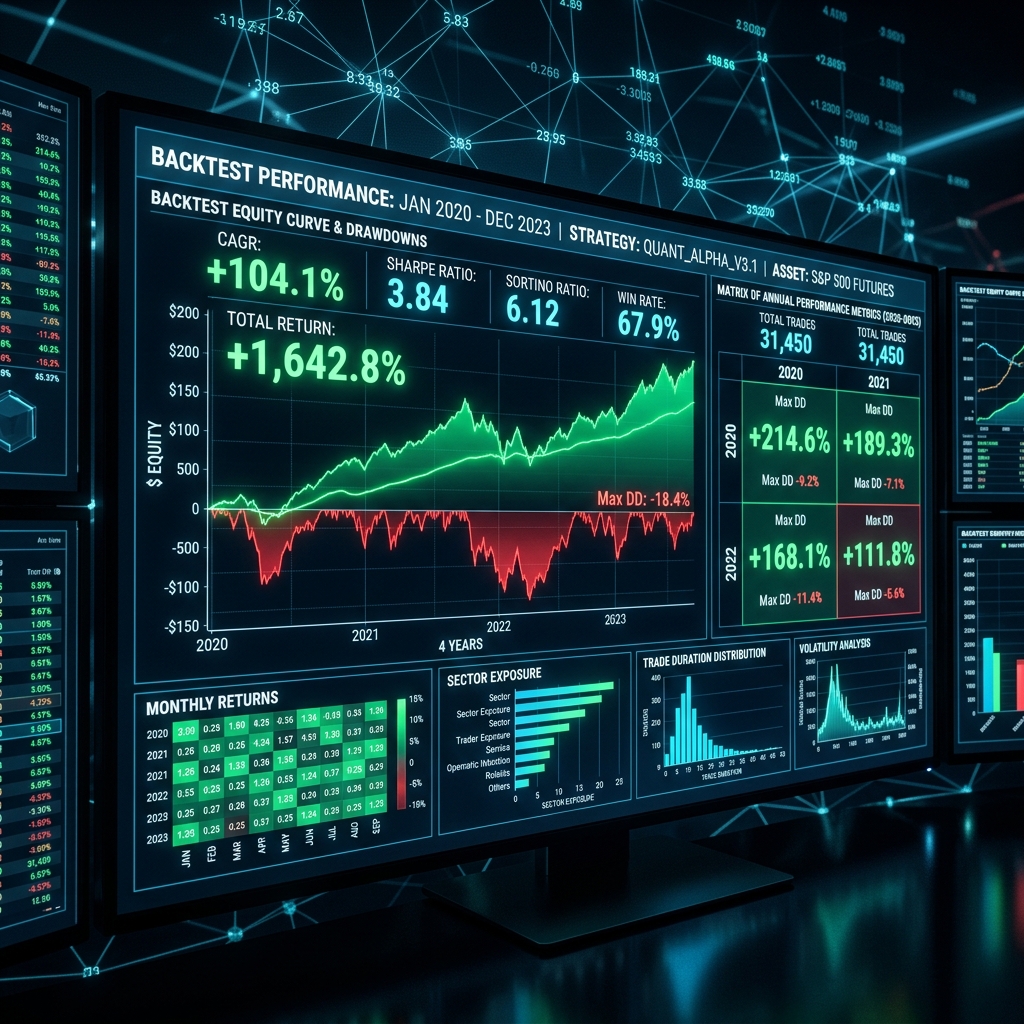
The Trap of the “Perfect” Backtest
If you spend enough time looking at historical cryptocurrency data, you can build an algorithm that turns $1,000 into $1,000,000 in a year. You can optimize moving average crosses, tweak RSI parameters, and train a neural network to perfectly buy the dips of the 2021 bull run.
This is called “curve-fitting,” and it is the single biggest destroyer of capital in algorithmic trading.
At CryptoQuantix, we’ve seen countless automated strategies fail when exposed to the harsh, random realities of live market conditions. An algorithm built solely to trade the 2021 liquidity injection will violently blow up the moment the Federal Reserve raises interest rates.
To prevent this, our quantitative research team implemented the 4-Year Validation Protocol, a brutal testing framework designed to simulate the worst possible market conditions over multiple market cycles. Only the strategies that survive this matrix are allowed into our production environment.
Step 1: The Out-Of-Sample Walk-Forward Matrix
Standard backtesting assumes that you train your model on historical data, and then you just let it run. In our engine, a model is never allowed to “see” the data it is being evaluated on.
We use a rigorous Walk-Forward Optimization approach.
Here is how our engine evaluates a new hypothesis:
- In-Sample Training (2018 - 2020): The engine optimizes parameters (like lookback periods for volatility filters) using only data from the previous bear market.
- Out-of-Sample Testing (2021 - 2022): The locked algorithm is then run over the subsequent two years. It has no prior knowledge of the massive 2021 bull run or the devastating 2022 crash.
- The Penalty Phase: If the out-of-sample performance metrics (Profit Factor, Maximum Drawdown) deviate by more than 15% from the in-sample expectations, the entire model is instantly discarded.
def walk_forward_validation(model, historical_data):
    """
    Simulates a rigorous walk-forward test to prevent curve-fitting.
    If the out-of-sample performance collapses, the model is rejected.
    """
    # Split data chronologically
    in_sample = historical_data.loc['2018':'2020']
    out_of_sample = historical_data.loc['2021':'2022']

    # Train model parameters on the past
    model.optimize(in_sample)

    # Test blindly on the future
    oos_results = model.run(out_of_sample)

    if oos_results.profit_factor < 1.5 or oos_results.max_drawdown > 0.30:
        raise ValidationError("Model Failed Out-Of-Sample Validation.")
    else:
        return "[PASS] Model Approved for Paper Trading."
By enforcing strict chronological isolation, we ensure that our strategies are not just memorable patterns from a specific bull run, but fundamental, structural inefficiencies that repeat across different macroeconomic environments.
Step 2: The Slippage Stress Test
As discussed in our previous research, live execution carries transaction costs. The exchanges charge fees, and market liquidity forces your orders to fill at worse prices than your signal price (slippage).
In our 4-Year Validation protocol, we do not use “ideal” execution modeling. We use punitive modeling.
Our backtest engine artificially subtracts 0.20% per round-trip trade (entry + exit). For a strategy that trades 100 times a year, this means the backtest is artificially penalized by 20% of gross capital annually.
If a strategy’s equity curve still points upwards at a 45-degree angle after absorbing this massive, artificial 20% annual drag, we know the mathematical edge is profound. We call this “Slippage Survival.”
class ExecutionSimulator:
    def execute_trade(self, signal_price, direction, size):
        # We assume the worst possible fill for conservative modeling
        artificial_slippage = 0.0020  # 0.20% penalty

        if direction == 'LONG':
            fill_price = signal_price * (1 + artificial_slippage)
        elif direction == 'SHORT':
            fill_price = signal_price * (1 - artificial_slippage)

        return fill_price
Step 3: Monte Carlo Parameter Perturbation
A robust algorithm should not fall apart if its parameters are slightly tweaked. If a strategy using a 50-day moving average is highly profitable, but fails completely if you use a 48-day or 52-day moving average, it is curve-fit garbage.
Before any algorithm is approved, it must pass a Monte Carlo Perturbation Test.
Our servers run 10,000 variations of the algorithm, randomly shifting all input parameters by +/- 10%. We then plot the distribution of outcomes. If the resulting bell curve shows that more than 5% of the variations result in negative equity or massive drawdowns, the strategy is scrapped.
A true mathematical edge is a wide plateau, not a sharp peak.
Step 4: The 2022 “Nuclear Winter” Test
The year 2022 was one of the most brutal environments in financial history. Global interest rates spiked, the FTX exchange collapsed, Terra/Luna vaporized $40 billion, and Bitcoin crashed over 70%.
For CryptoQuantix, the 2022 bear market is our ultimate proving ground. We isolate the data from January 2022 to December 2022 and feed it to our models.
The mandate is simple: Do not lose money.
Our macro-cyclical models passed this test with flying colors. By strictly respecting the 200-Day Moving Average, our engine spent almost the entirety of 2022 in cash. It sidestepped the Luna collapse, the Celsius bankruptcy, and the FTX implosion.
While the rest of the industry was trying to “buy the dip” and getting liquidated, our algorithms calmly preserved capital.
“Capital preservation is the ultimate alpha. If you don’t lose your chips when the casino is rigged against you, you will have the maximum possible leverage when the odds inevitably shift back in your favor.”
Open Sourcing the Validation Framework
We believe that the financial industry relies too heavily on black-box algorithms and unverifiable claims. That is why the core of our 4-Year Validation Protocol, including the slippage penalty matrix and the Walk-Forward optimizer, is available on our GitHub repository.
We encourage researchers, quant developers, and skeptics to fork our code, run the historical tick data, and try to break our models. Because we already tried—and our models survived.
The rigorous process of validation is tedious, computationally expensive, and often soul-crushing when a beautiful idea fails the test. But it is the only way to build systems that endure.
Ready to Launch Your
Quantitative Engine?
Stop trading manually. Start scaling. Configure the infrastructure and CryptoQuantix handles market data, risk, and execution — 24/7, automatically.
You might also be interested in...

The June 2026 Pivot: Why HFT Failed and Macro Trend Following Won
The Illusion of the Intraday Edge
ReadDiscover CryptoQuantix
Quantitative trading strategies and portfolio management for crypto perpetuals.
View Source Code