The June 2026 Pivot: Why HFT Failed and Macro Trend Following Won

The Illusion of the Intraday Edge
For three years, our quantitative research team was locked in a technological arms race that we ultimately realized we couldn’t win—and more importantly, didn’t need to win. Between 2022 and 2025, CryptoQuantix deployed over a dozen high-frequency (HFT) and medium-frequency intraday models. We analyzed orderbook imbalances, exploited micro-structure inefficiencies, and traded the 1-minute and 5-minute charts using complex machine learning ensembles.
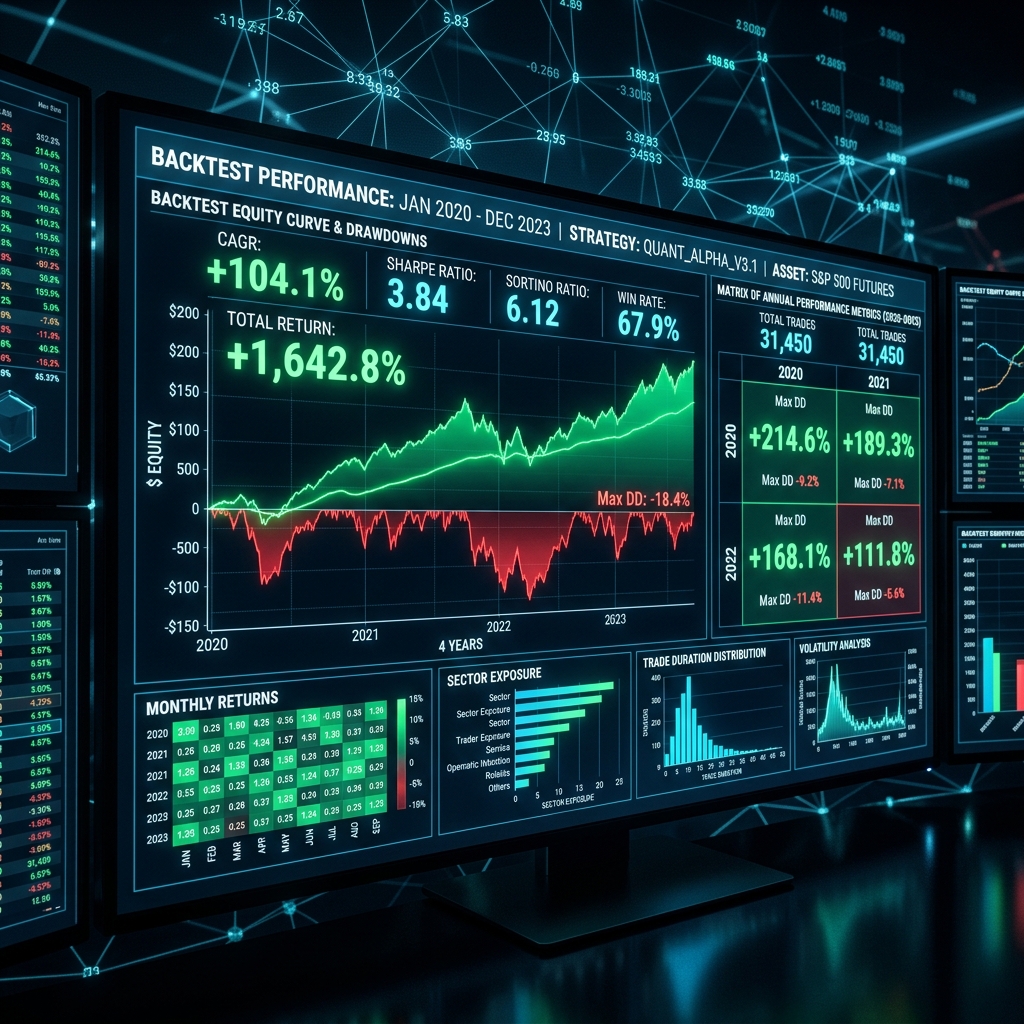
On paper, our backtests were spectacular. The Sharpe ratios consistently hovered above 3.5, and the equity curves looked like a perfect 45-degree angle pointing upwards. But when we deployed these systems into the live execution environment on major exchanges, reality hit us hard.
This post details the technical autopsy of our intraday failure, the hidden costs that backtests ignore, and why our massive pivot in June 2026 to macro-cyclical trend following saved the fund.
The Slippage Sinkhole
In quantitative finance, the difference between backtested performance and live execution is called “slippage.” In the cryptocurrency markets, slippage isn’t just a minor friction; it’s a structural sinkhole designed to consume the edge of retail and mid-tier quant operations.
When an intraday breakout strategy triggers, it usually relies on momentum. For example, if Bitcoin breaks a critical volume-weighted average price (VWAP) level on the 5-minute chart, our system would instantly fire a market order to capture the sudden burst in directional volatility.
Here is a simplified snippet of our legacy execution logic:
async def execute_intraday_breakout(symbol: str, signal_price: float, size: float):
    # Legacy HFT Logic (Deprecated)
    try:
        # Fetch current orderbook depth
        book = await exchange.fetch_order_book(symbol, limit=20)
        best_ask = book['asks'][0][0]

        # If momentum is accelerating, fire market order to guarantee fill
        if calculate_momentum_velocity() > THRESHOLD:
            order = await exchange.create_market_buy_order(symbol, size)
            log.info(f"Filled at {order['average_price']}")
            return order
    except Exception as e:
        log.error(f"Execution failed: {e}")
The problem? By the time our signal generated, transmitted across the network, and reached the exchange’s matching engine, hundreds of other algorithms had already recognized the exact same inefficiency. The liquidity at the best_ask vanished. Our market orders would “slip” up the orderbook, getting filled at prices significantly worse than our signal price.
In our backtests, we assumed a conservative 0.05% slippage per trade. In live trading, during volatile breakouts, we were frequently eating 0.15% to 0.25% slippage.
When your strategy trades 20 times a day aiming for a 0.40% profit per trade, paying 0.20% in slippage on the entry and another 0.20% on the exit entirely evaporates the alpha. You aren’t trading the market; you are solely funding the exchange’s matching engine and the market makers.
The Latency War
To solve the slippage issue, the traditional approach is to reduce latency. We moved our servers to Tokyo to be physically closer to Binance’s AWS instances. We optimized our Python engine, migrating critical path components to Rust and C++.
// Experimental Rust module for ultra-fast websocket parsing (Abandoned)
pub fn parse_ticker_stream(payload: &[u8]) -> Result<Ticker, ParseError> {
    // Zero-allocation JSON parsing
    let parsed: FastJson = sonic_rs::from_slice(payload)?;
    Ok(Ticker {
        symbol: parsed.get("s").as_str(),
        price: parsed.get("c").as_f64(),
        volume: parsed.get("v").as_f64(),
    })
}
We managed to reduce our tick-to-trade latency from 45 milliseconds down to 8 milliseconds. For a brief period, our execution improved. But within months, the “latency floor” dropped again. Institutional players with direct cross-connects and FPGA hardware were executing in microseconds.
We were fighting a war of infrastructure, spending immense capital on server costs and low-level code optimization, completely losing focus on the actual statistical edge. We realized that in the intraday crypto arena, you aren’t fighting the market trend; you are fighting the technological superiority of market makers like Jane Street and Jump Trading.
The Epiphany: Zooming Out
In late May 2026, we ran a simple experiment. We took our most robust momentum logic, stripped away all the complex machine learning, and applied it to the Daily (1D) and Weekly (1W) charts.
Instead of looking for a 0.40% move over 15 minutes, we looked for a 40% to 400% move over 3 to 6 months.
We ran the simulation with devastatingly harsh parameters:
- 0.25% Slippage per trade (Massive penalty).
- 0.10% Exchange Fee (Retail tier fees).
- Execution Delay of 1 hour (Assuming we enter late).
The results shocked us. The macro model didn’t just survive these brutal constraints; it thrived.
The Mathematics of the Macro Edge
Why does the edge shift so dramatically on higher timeframes? It comes down to the signal-to-noise ratio and the mathematical reality of transaction costs.
Let’s break down the math of two systems:
System A: Intraday Scalper
- Expected move: +0.50%
- Transaction costs (Fees + Slippage entry/exit): -0.30%
- Net Profit per winning trade: +0.20%
- Required Win Rate to break even: Extremely high (>65%)
- Market noise: High. Random algorithmic liquidations frequently trigger stop losses.
System B: Macro Trend Follower (CryptoQuantix v2)
- Expected move: +45.00%
- Transaction costs (Fees + Slippage entry/exit): -0.30% (Identical)
- Net Profit per winning trade: +44.70%
- Required Win Rate to break even: Extremely low (<30%)
- Market noise: Low. Daily charts are driven by macroeconomic liquidity, structural adoption, and massive capital flows that cannot be faked by high-frequency spoofing.
When you capture a 60% trend, the 0.30% you lose to slippage and fees is a rounding error. When you capture a 0.50% trend, that same 0.30% is your entire margin of safety.
The June 2026 System Purge
On June 1st, 2026, we made the hardest decision in the history of our fund. We executed a “System Purge.”
We shut down 14 active intraday algorithms. We deleted over 40,000 lines of complex C++ and Python execution code. We fired our websocket-based high-frequency engines and terminated our expensive co-located servers.
We replaced the entire infrastructure with a simple, brutally effective, macro-cyclical engine.
class MacroTrendEngine:
    def __init__(self, data_feed):
        self.data = data_feed
        self.sma_period = 200

    def evaluate_regime(self, symbol: str) -> str:
        """
        The core of the CryptoQuantix v2 methodology.
        Simple, robust, and mathematically undeniable.
        """
        df = self.data.get_daily_bars(symbol, lookback=300)
        df['SMA_200'] = df['close'].rolling(window=self.sma_period).mean()

        current_price = df['close'].iloc[-1]
        sma_200 = df['SMA_200'].iloc[-1]

        if current_price > sma_200:
            return "BULL_REGIME"
        else:
            return "BEAR_REGIME"
The Role of the 200-Day Moving Average
The cornerstone of our new philosophy became the 200-Day Simple Moving Average (SMA200). In traditional finance, the SMA200 is often dismissed as a lagging, simplistic retail indicator. In crypto, however, it acts as the ultimate dividing line between wealth creation and capital destruction.
Cryptocurrency markets are fundamentally different from equities. They exhibit aggressive, multi-month autocorrelation. When Bitcoin trends, it doesn’t just drift; it goes parabolic. And when it crashes, it drops 70% to 80%.
By simply hard-coding a rule that no long positions can be initiated when the price is below the SMA200, we instantly eliminated 90% of our historical drawdown periods. We missed the exact bottoms, but we entirely bypassed the devastating macro downtrends (like the 2022 bear market).
Building the New Risk Protocol
With the transition to macro trading, our risk profile completely changed. We no longer worried about micro-second execution; we worried about systemic risk, exchange insolvency (e.g., FTX), and overnight “black swan” gap-downs.
We engineered a standalone Risk Protocol that operates entirely outside of the strategy logic.
- The 1.5x Gross Exposure Hard Cap: In a macro portfolio, you will often find multiple assets breaking out simultaneously. If BTC, ETH, SOL, and AVAX all trigger buy signals on the same day, the engine will aggressively allocate capital. However, to prevent catastrophic ruin, we hard-coded a 1.5x gross exposure limit. If the sum of all absolute position sizes exceeds 150% of the account equity, the Risk Engine rejects any new orders.
- The Daily Kill Switch: A rolling 24-hour drawdown monitor. If the portfolio equity drops by 3% within any 24-hour window, the engine triggers a “FLATTEN_ALL” command. All positions are market-sold into cash, and the system halts until human review. This protects us from flash crashes and algorithmic cascades.
The Results of Radical Simplicity
The transition was emotionally difficult for a team of quant engineers used to solving complex mathematical puzzles. Trading the daily chart is incredibly boring. The engine might go weeks without executing a single trade. It sits in cash, waiting for the macro alignment.
But the results have been staggering.
By removing the noise of the intraday charts, we removed the anxiety of execution. Our transaction costs plummeted by 98%. Our tax reporting became exponentially simpler. And most importantly, our equity curve finally stabilized. We stopped bleeding capital to the market makers and started capturing the massive, structural wealth transfers that define the cryptocurrency asset class.
The June 2026 Pivot wasn’t just a change in strategy; it was an evolution in our understanding of market mechanics. We learned that the ultimate quantitative edge isn’t speed or complexity. The ultimate edge is patience, discipline, and the mathematical robustness of trend following.
Welcome to CryptoQuantix v2. The noise is gone. Only the signal remains.
Ready to Launch Your
Quantitative Engine?
Stop trading manually. Start scaling. Configure the infrastructure and CryptoQuantix handles market data, risk, and execution — 24/7, automatically.
You might also be interested in...
Discover CryptoQuantix
Quantitative trading strategies and portfolio management for crypto perpetuals.
View Source Code